
January in Ohio isn’t just cold; it’s a full-on combat zone for drivers. The Old Farmer’s Almanac 2026 winter forecast, combined with NOAA’s latest outlook, is calling for three major Arctic blasts, above-average lake-effect snow, and multiple rounds of freezing rain that could make January 2026 the most dangerous driving month in the past five years.
ODOT’s preliminary data already shows January consistently produces the highest monthly crash totals in Ohio — 18,427 crashes in January 2025 alone. When you add the predicted weather extremes, the stage is set for carnage on I-71, I-90, I-270, and every rural county road.
Hazard #1 – Black Ice on Bridges and Overpasses
Bridges and overpasses freeze long before the road surface. With three Arctic outbreaks forecast to drop temperatures to -10 °F or lower in Columbus, Cincinnati, and Dayton, every elevated structure becomes a skating rink.
Real-world proof
- January 8, 2025: 47-vehicle pileup on the Brent Spence Bridge (I-75) caused by a 100-foot patch of black ice. Six injuries, four drivers cited for reckless operation (4 points each).
- January 14, 2025: 19-car chain reaction on the I-480 Valley View Bridge when a semi lost traction on invisible ice.
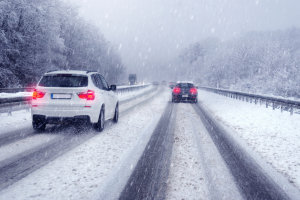 Why it’s worse in 2026
NOAA predicts overnight lows of -12 °F to -18 °F in central Ohio during the Jan 14-18 blast — cold enough for black ice to form even on salted roads.
Survival tactics
- Slow down 15-25 mph below the posted limit the moment the temperature is ≤ 20 °F.
- Ease off the brake when crossing bridges; use engine braking in a lower gear.
- If you start to slide, steer into the skid and NEVER slam the brakes — that’s what triggers the 4-point reckless citation.
Hazard #2 – From Clear Skies to White-Out in 30 Seconds
The infamous Snow Belt (Erie, Ashtabula, Geauga, Lake, and northern Cuyahoga counties) will be ground zero for intense squalls. The Almanac calls for 6–10 squall events in January 2026, some dropping 3–5 inches in under an hour.
January 2025 stats
312 crashes on I-90 between Erie, PA and Cleveland attributed directly to sudden white-outs. Troopers issued 187 “failure to control” citations (2 points each).
Why 2026 will be deadlier
Stronger northwest flow behind the Arctic fronts will create longer-lasting, more intense bands. Visibility can drop from 5 miles to 20 feet in seconds.
Survival tactics
- If you see a wall of white approaching, immediately signal and take the next exit — never stop on the shoulder.
- Turn on hazards and low beams only (high beams reflect back in heavy snow).
- Keep an emergency kit with blanket, food, water, and a shovel — many drivers were stranded 4+ hours in 2025 squalls.
Hazard #3 – Freezing Rain and Ice Glaze
Southern and central Ohio are in the crosshairs for three major ice events: Jan 3-4, Jan 12-13, and Jan 22-24. Even 0.10–0.25 inch of ice accumulation shuts down I-70, I-75, and every secondary road.
Historical horror
January 27-29, 2023 ice storm caused 1,114 crashes statewide in 48 hours. Troopers wrote 412 reckless operation tickets to drivers exceeding 25 mph on glare ice.
What to expect in 2026
Models show warm air overriding Arctic air — classic freezing rain setup for Dayton, Springfield, Chillicothe, and Portsmouth.
Survival tactics
- If trees and power lines are glistening, assume every road is glare ice.
- Maximum safe speed on ice: 15-20 mph with both hands on the wheel.
- If you must travel, carry traction aids (kitty litter or sand) and know how to rock out if stuck.
Hazard #4 – Snow-Covered Lane Markings and Plow Lag
With back-to-back storms, ODOT’s 1,400 plows will be overwhelmed. Rural routes like US-33, SR-161, and SR-315 often go 12–24 hours between passes.
Danger
Drivers drift into oncoming traffic or off the road because lane lines disappear under packed snow. In January 2025, 68% of rural wrong-way crashes cited “no visible markings.”
Survival tactics
- Treat the road as if it has no lines — stay center of the traveled portion.
- Use GPS apps with lane guidance (Waze, Google Maps).
- Watch the tree line or telephone poles for orientation on two-lane roads.
Hazard #5 – Deer on Ice: A Lethal January Combo
January is peak deer dispersal after hunting season. Add ice and you get deer sliding directly into traffic.
Stats
1,812 deer-related crashes in January 2025 — highest monthly total. Many occurred on SR-4, SR-161, and SR-315.
Survival tactics
- Slow down dramatically at dawn and dusk.
- If a deer is on the shoulder, brake firmly but DO NOT swerve — most serious crashes occur when drivers overcorrect.
Hazard #6 – The Deadly Afternoon Refreeze
Central Ohio often sees daytime highs of 33-36 °F that melt snow on roads and parking lots, followed by sunset plunges below 20 °F. Everything that was slush at 4 p.m. becomes black ice by 6 p.m.
Proof
214 crashes in greater Cleveland between 5-8 p.m. after a daytime thaw in January 2025.
Survival tactics
- Assume any wet pavement after 3 p.m. will be ice by nightfall.
- Park facing out in lots to avoid backing on ice.
- Walk like a penguin on suspected ice — small steps, flat feet.
Why January 2026 Will Be Worse Than Average
- Three confirmed Arctic outbreaks (Jan 4-7, Jan 14-18, Jan 25-29)
- Above-average lake-effect snow for the Snow Belt
- Higher-than-normal freezing rain probability for southern Ohio
These Ohio winter driving hazards routinely add 2–6 points to licenses when drivers aren’t prepared.
 How to Stay Off the Trooper’s Radar in January 2026
- Leave 30–60 minutes earlier — speeding in winter is the #1 ticket cause.
- Keep tires above 6/32″ tread and pressure at 35–40 psi (cold drops pressure 1 psi per 10 °F).
- Triple your following distance — 8–10 seconds instead of 3–4.
- If you do get a ticket for skidding or equipment, our Ohio BMV-approved course earns you a 2-point credit.
Don’t Let Winter Driving Hazards Suspend Your License
One bad skid or equipment ticket in a storm can easily push you over 12 points fast when winter citations pile up. Our 8-hour online remedial course is the fastest, cheapest way to earn a 2-point credit and keep driving legally. Check out our course to learn more or sign up today!
Common FAQS About Winter Driving Hazards
1. What are the biggest Ohio winter driving hazards in January 2026?
Black ice on bridges, lake-effect snow squalls, freezing rain, snow-covered lane markings, deer on ice, and deadly afternoon refreezes top the list of Ohio winter driving hazards.
2. Why is black ice the #1 hazard for Ohio winter driving in 2026?
With Arctic blasts dropping temps to -18 °F, bridges and overpasses will freeze instantly, causing pileups like the 47-car crash on the Brent Spence Bridge in 2025.
3. Where do lake-effect snow squalls hit hardest in Ohio?
Erie, Ashtabula, Geauga, Lake, and northern Cuyahoga counties along I-90 will see the most intense Ohio winter driving hazards from sudden white-outs.
4. How much ice makes Ohio roads undrivable in January 2026?
Even 0.10–0.25 inch of freezing rain (forecast three times in January) turns I-70 and I-75 into glare ice, triggering 4-point reckless driving tickets.
5. Why do lane markings disappear and cause crashes?
Back-to-back storms overwhelm ODOT plows; 68% of rural wrong-way crashes in January 2025 happened because lane lines were buried—one of the sneakiest Ohio winter driving hazards.
6. When are deer collisions most dangerous in Ohio winters?
January is peak dispersal after hunting season; deer sliding on ice across SR-4, SR-161, and SR-315 caused 1,812 crashes last January.
7. What is the afternoon refreeze trap in January 2026?
Daytime highs of 33–36 °F melt snow, then sunset plunges below 20 °F turn every wet surface into black ice by 6 p.m.—a hidden Ohio winter driving hazard.
8. How many points can one winter skid add to my Ohio license?
Failure to control = 2 points, reckless operation on ice = 4 points; one bad slide can push you toward a 12-point suspension fast.
9. How does the Online Two Point Driving Classes course help in January 2026?
Our $69.95, 8-hour Ohio BMV-approved online course earns a 2-point credit—your lifeline if you pick up a winter citation.
10. Why is January 2026 expected to be worse than normal for Ohio winter driving hazards?
Three Arctic outbreaks, above-average lake-effect snow, and multiple ice storms combine to make it potentially the most dangerous driving month in years.